SAVE YOURSELF FROM FAKE PROBLEMS
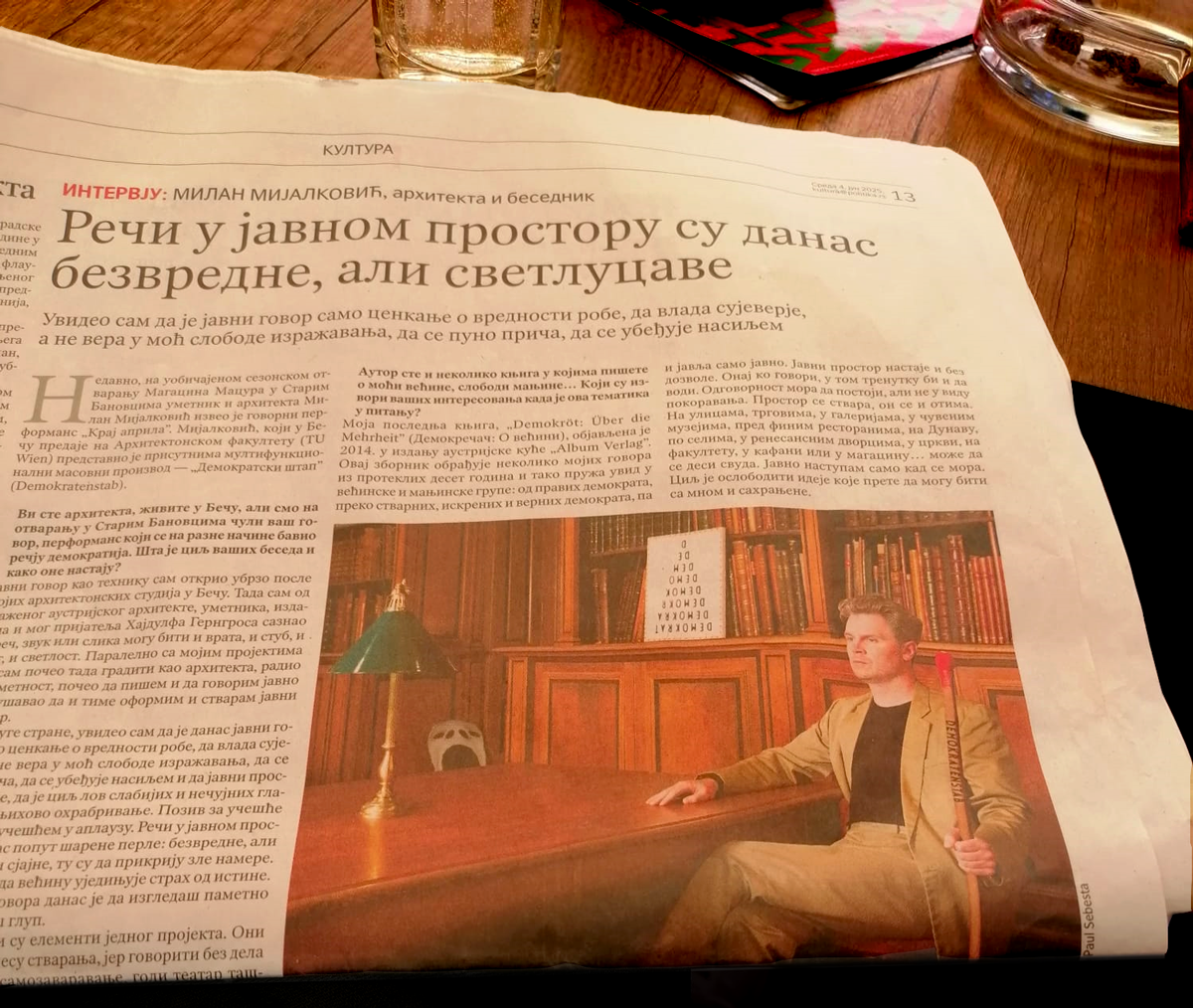
Interview: Milan Mijalkovic, architect and bearer of the Democratic Staff
by Marija Đorđević for Politika 04/06/2025 Read the original interview in Serbian here
Recently, at the customary seasonal opening of the Museum Macura in Stari Banovci, artist and architect Milan Mijalkovic delivered his speech-performance “The End of April”. Mijalkovic, who teaches at the Faculty of Architecture in Vienna (TU Wien), presented the audience with a multifunctional, mass-produced product — the "Democratic Staff" (Demokratenstab)
You are an architect, living in Vienna, but at the opening in Stari Banovci, we heard your speech — a performance that dealt with the word “democracy” in various ways. What is the goal of your speeches, and how do they come about?
I discovered public speaking as a technique shortly after finishing my architectural studies in Vienna. It was then that I learned from the distinguished Austrian architect, artist, publisher and my friend Heidulf Gerngross that a word, a sound or an image can also be a door, a pillar, a bridge and light. Alongside the projects I began building as an architect, I was making art, began writing and speaking publicly, and tried through these means as well to shape and create public space.
On the other hand, I realised that public speech today is merely haggling over the value of commodities; that superstition prevails rather than faith in the power of free expression; that there is a lot of talking, that people are persuaded through violence, and that public space is disappearing; that the aim is to hunt down the weaker, silent voices, rather than encourage them. An invitation to participate is an invitation to participate in applause. Words in public space today are like colourful beads: worthless, but glittering and shiny, there to conceal bad intentions. I realised that the majority is united by a fear of the truth. The goal of public speaking today is to look smart while playing dumb.
My speeches are elements of one project. They emerge in the process of making, because speaking without doing is merely public self-deception, the naked theatre of vanity. The aim is to create possibilities, not merely offer a choice without an alternative. The aim is to recognise good deeds and repeat them. To save oneself from fake problems. To share experience…
What was your first public appearance?
It was the speech Terrorism Gallery (Terrorismus Galerie) in 2012. Its purpose was to mark the beginning of a new artistic space, and it also served as an act of personal liberation from any form of irresponsibility. In 2016, The Democratic Speech was a speech everyone could understand, and everyone already knew by heart. The democratic word "shh…" hushed and calmed the audience and called them to dream; letting everything reveal itself on its own — without noise, without agitation. That sound, normally heard in libraries and before falling asleep, became the central figure of the rhetoric.
The 2019 speech “All-Embracing Satisfaction: On the Apolitical” points out that the aim today is not to make things good for everyone, because that would mean the death of the political system. This speech was also published as a book that same year under its original German title, Allumfassende Zufriedenheit: Über das Apolitische. And the 2024 project Imminent Destrucion establishes a framework and proposes a list of fundamental democratic postulates. These are some examples…
You are also the author of several books dealing with the power of the majority and the freedom of the minority… What are the sources of your interest in these questions?
My latest book, Demokröt: Über die Mehrheit (Democroak: On the Majority), was published in 2014 by the Austrian publishing house Album Verlag. The volume reworks several of my speeches from the preceding ten years and offers a glimpse into majority and minority groups: spanning from true democrats, through real, sincere, and faithful democrats, to over-democrats and un-democrats, all the way to today's democrats and the newest breed — the democroakers.
The sources are people… Recently, on Radio Belgrade 2, I heard that “you never know from whose mouth the truth may come.” You never know where the gods may speak from. Today there are countless possibilities; sources are everywhere around us, and the devil, of course, never sleeps… manipulation and lies are everywhere. I would recommend the Egyptian Ma'at, Aristophanes and Lucian.

It is unusual for an architect to enter what we might call the socio-political sphere… What are your motives?
Architecture is, of course, also politics. Public space is not a neutral stage. But my motive is not to enter politics — it is to never leave it. Space is not created only from brick and concrete, or from preaching, but also from emotions, encouragement, shared chatter, laughter, shared learning, shared needs or concerns. Human connections create miracles. One has to be careful…
Where do you perform your talks?
Talks are nice… People sit comfortably and chat. But public speech is a public performance; there is no arguing. It is not a war of words, nor an app on a phone. The public is not the internet. The public happens and comes into being only in public. Public space comes into being without permission. Whoever speaks, at that moment, also wants to lead. Responsibility must exist, but not in the form of submission. Space is created; it is also taken away. On streets, in squares, in galleries, in famous museums, in front of fine restaurants, by the Danube, in villages, in Renaissance castles, in churches, at universities, in taverns or in warehouses… it can happen anywhere. I perform publicly only when I have to. The aim is to free ideas that threaten to be buried along with me.
What is your contribution as an architect to the Macura Museum, namely the New Warehouse?
Well, I would say the additions to the warehouse in Stari Banovci are joint projects with Vladimir Macura. Some are my initiatives, some are his… We talk, then I sketch it, and by the next day he has built it and refined the space.
Could you tell us more about your origins — there is Macedonian and Serbian blood in you, and what else?
My mother, Ljubica, is Macedonian, as is my grandmother Spasija, who is from the city of Prilep. My grandfather Milivoje was from Bosnia, where he lost his family at the beginning of the Second World War and became a partisan squad leader at the age of fourteen. I was born and lived in Skopje until I was eighteen. My father was born in Belgrade. His great-grandfather was Gligorije Janković, who, together with his wife Astrid Kupka, originally from Vienna, owned the factory Merima - Kruševac. On the other side was my great-great-grandfather, Colonel Jovica M. Miletić. My children were born in Vienna…
Plums make both marmalade and alcohol. If you ask me who I am — as long as I hold this democratic staff, I am a Scythian, a Macedonian Hellene.
04/06/2025
Foto Credits: Paul Sebesta
End
Top
© 2025 Milan Mijalkovic. All rights reserved.